- Free Consultation 24/7: (800) 337-7755 Tap Here to Call Us












How to Get a Police Report After an Accident in Miami


To get a Miami accident police report, you can usually request it from the agency that responded to your crash, such as the City of Miami Police Department, the Miami-Dade Sheriff’s Office, or the Florida Highway Patrol, or order it online through the state’s Florida Crash Portal. We can help you request it. Call 800-337-7755.
After a crash, most people feel shaken, sore, and unsure what to do first. Getting the police report is often one of the earliest and most useful steps. It can help you deal with insurance companies, track down witnesses, and understand how the officer viewed the crash. This guide explains how the process generally works in Miami and what you may want to do while you wait.
Why the Police Report Matters After a Miami Crash
A crash report is often the first official record of what happened. It typically lists the drivers, vehicles, insurance information, the location and time, road and weather conditions, any citations issued, and a short narrative or diagram from the investigating officer. Insurance adjusters often look at it early when deciding how to handle a claim.
The report is not the final word on who was at fault. Officers usually arrive after the crash has happened and rely on what they see and what people tell them. Still, the report can point you toward evidence that may support your claim, such as witness names or a note that the other driver was cited.
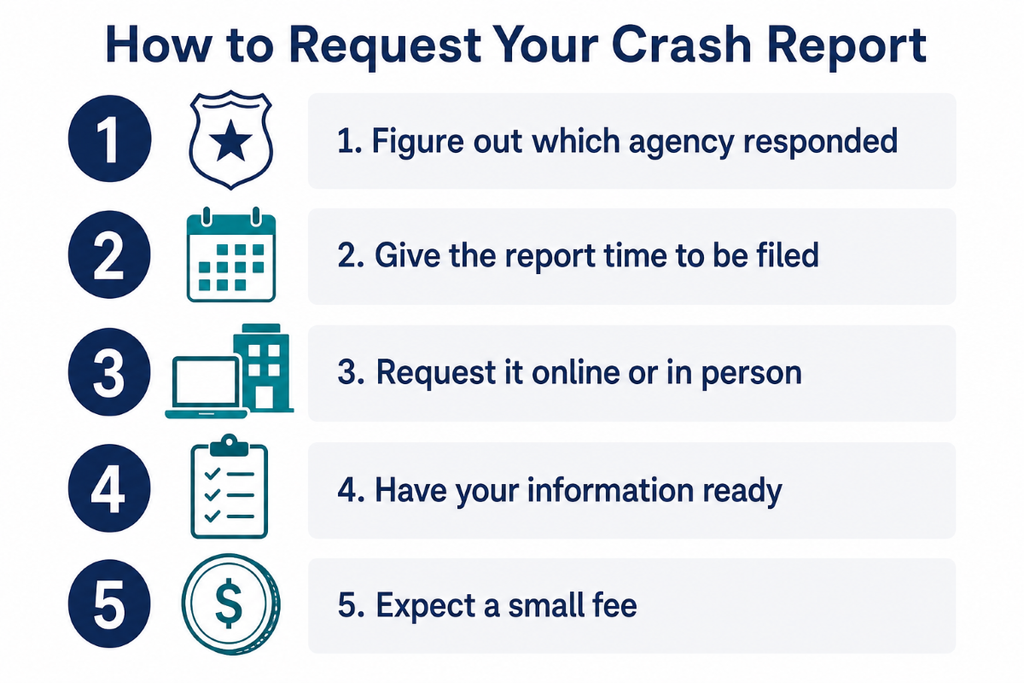
Step by Step: How to Request Your Crash Report
- Figure out which agency responded. Look at any card or paper the officer gave you at the scene. It may show the agency name and a report or case number. Crashes in the City of Miami are often handled by the Miami Police Department, while unincorporated areas are generally handled by the Miami-Dade Sheriff’s Office (formerly the Miami-Dade Police Department). Highway crashes are often handled by the Florida Highway Patrol. Cities like Miami Beach, Hialeah, and Coral Gables have their own departments.
- Give the report time to be filed. Reports are not always available right away. It can take several days or longer for an officer to complete and submit one.
- Request it online or in person. Many Florida crash reports can be ordered through the Florida Crash Portal on the Florida Department of Highway Safety and Motor Vehicles website. You may also be able to contact the records unit of the responding agency directly.
- Have your information ready. This usually includes the date of the crash, the location, your name, and the report number if you have it.
- Expect a small fee. Agencies and the state portal often charge a modest fee for a copy.
The 60-Day Confidentiality Period
Under Florida law, crash reports are generally kept confidential for the first 60 days after they are filed. During that window, access is usually limited to the people involved in the crash, their attorneys, their insurers, and certain other authorized parties. You may be asked to sign a sworn statement confirming you are allowed to receive the report. After 60 days, the report typically becomes available to the public.
This rule exists in part to protect crash victims from unwanted solicitation. If you are having trouble getting through the paperwork, a lawyer representing you can often request the report on your behalf.
What If No Officer Wrote a Report?
Sometimes police do not come to the scene, especially when a crash seems minor or in a hit-and-run accident in Miami where the other driver flees. In some situations, Florida law may require drivers to submit their own written crash report to the state within a set number of days. If you are unsure whether that applies to you, it may be worth getting guidance quickly so you do not miss a deadline.
Read Your Report Carefully and Look for Errors
Once you have the report, review it line by line. Mistakes happen. Common problems include:
- Wrong names, plate numbers, or insurance details
- Missing witnesses
- A narrative that leaves out your side of the story
- Injuries listed as “none” when you were actually hurt
If something is wrong, you may be able to ask the agency to correct factual errors or add a supplemental statement. An officer’s opinion is harder to change, but other evidence can often be used to challenge it.
Other Steps to Take While You Wait
- Get medical care quickly. Florida’s personal injury protection (PIP) rules generally require that you seek treatment within 14 days of the crash to use those benefits.
- Save your evidence. Keep photos, videos, medical records, and receipts. Nearby businesses may have security footage that gets erased over time.
- Be careful with insurance adjusters. The other driver’s insurer may ask for a recorded statement. You may want to speak with a lawyer first.
- Watch the clock. Florida generally gives people a limited time to file an injury lawsuit, and for many negligence claims that period is now two years.
Examples of How a Police Report Can Shape a Claim
The following are general, hypothetical scenarios meant to show how reports can come into play. They are not actual case results.
A rear-end crash on a busy Miami road. A driver is struck from behind at a red light. The report notes the other driver was cited for following too closely. That citation may help support the injured driver’s position with the insurer, although the claim still depends on medical records and other evidence.
A disputed intersection crash. Two drivers each say they had a green light. The report lists a pedestrian witness whose name neither driver caught at the scene. Contacting that witness may become an important part of building the claim.
A report with a key mistake. An injured passenger finds that the report lists no injuries because she did not feel pain until hours later. Her medical records from the emergency room the next morning may help show the real picture.
One thing to keep in mind: The police report is generally not admissible in the civil case at trial. While it can help shape the case, the report itself is generally not admissible.
How the Law Offices of Jason Turchin Can Help
Our team can help request your crash report, review it for errors, gather witness information, and handle communication with insurance companies. We can also help organize medical records and evaluate what your claim may be worth. If you are wondering whether hiring counsel makes a difference, read our article on whether a lawyer can get more money for an accident claim.
Jason Turchin, Esq. has been recognized by Super Lawyers every year from 2020 through 2026, and as a Super Lawyers Rising Star in earlier years. He holds an AV Preeminent peer rating from Martindale-Hubbell, received the 2026 Martindale-Hubbell Client Champion Platinum Award, and has a 10.0 Superb rating on Avvo. The firm has been A+ rated by the BBB since 2014. Jason is also a #1 best-selling author on Amazon on accident law and has been featured by outlets including CBS Evening News, CNN, USA Today, The Washington Post, and The New York Times. Learn more about our experienced Miami personal injury lawyers.
Frequently Asked Questions
How long does it take to get a police report in Miami?
It varies. Some reports may be available within several days, while others can take longer depending on the agency and the complexity of the crash.
Can my lawyer get the police report for me?
Yes, an attorney representing someone involved in the crash can generally request the report, including during the 60-day confidentiality period.
Is the police report admissible in court?
Florida law generally limits the use of crash reports as evidence at trial. However, the information in the report can still help guide the investigation and insurance negotiations.
What if the report says I caused the crash?
The officer’s opinion is not necessarily the final answer. Florida follows a modified comparative negligence system, and other evidence may show the other driver shared fault or was mainly responsible.
Do I need the report to file an insurance claim?
Not always, but insurers often request it. Having a copy can help you check the facts the adjuster is relying on.
Talk to an Experienced Miami Accident Lawyer
Getting your police report is an important first step, but it is only one piece of a much larger picture. If you were hurt in a crash in Miami or elsewhere in South Florida, we may be able to help you understand your options and take the next steps with confidence. Call 800-337-7755 or contact us online to talk with our team.
