- Free Consultation 24/7: (800) 337-7755 Tap Here to Call Us












Can You Still Get Life Insurance Benefits If Your Claim Was Denied for Misrepresentation?


Yes, in many cases. If a life insurer denied a claim or rescinded a policy over life insurance misrepresentation on the application, beneficiaries may still be able to collect by showing the statement was not material, was an honest mistake, was the agent’s error, or that the contestable period had ended. Call 800-337-7755 to discuss your options.
Few things feel worse than losing a loved one and then receiving a letter saying the life insurance company will not pay. These letters often point to something on the original application, such as a health condition, a medication, a smoking habit or a prior diagnosis the insurer says was left out or answered incorrectly. The company may say it is “rescinding” the policy, refunding the premiums and walking away.
A misrepresentation denial is not always the final word. Insurance companies must follow the law and their own policy terms, and in our experience many of these denials can be questioned. Below we explain how these denials work and the ways beneficiaries may be able to challenge them.
What Is a Misrepresentation Denial?
When someone applies for life insurance, they usually answer questions about their health, lifestyle, finances and medical history. The insurer uses those answers to decide whether to issue the policy and what to charge. If the insured person dies and the insurer later finds an answer it believes was false or incomplete, it may deny the claim and try to cancel the policy as if it never existed.
Insurers commonly point to issues such as:
- Undisclosed medical conditions, such as heart disease, diabetes or high blood pressure
- Tobacco or nicotine use
- Prior alcohol or substance use treatment
- Prescriptions or doctor visits not listed on the application
- Hazardous hobbies or occupations
- Prior applications that were declined by other insurers
An insurer finding an incorrect answer does not automatically mean it can lawfully refuse to pay. The details matter, and that is where a beneficiary may have room to push back.
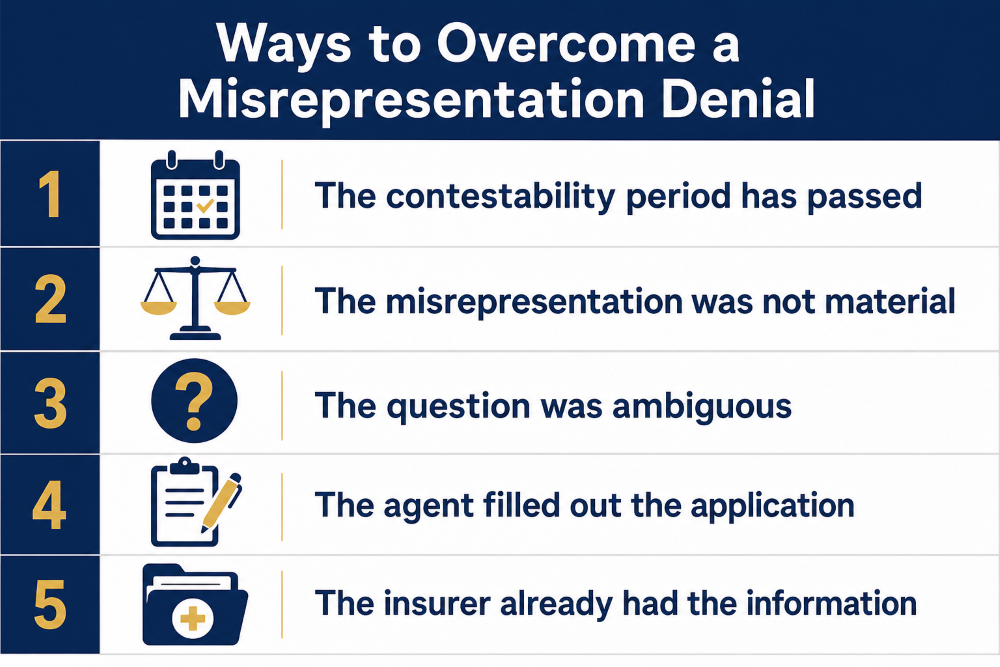
Ways to Overcome a Misrepresentation Denial
Every case is different, but these are some of the most common ways a misrepresentation denial may be challenged.
1. The Contestability Period Has Passed
Most life insurance policies include an incontestability clause. In Florida, Section 627.455 of the Florida Statutes generally requires life policies to become incontestable after they have been in force for two years during the insured’s lifetime, with limited exceptions such as nonpayment of premium. New York and New Jersey have similar two-year rules. If the insured passed away after that window closed, the insurer may be very limited in its ability to deny the claim based on application answers, even if an answer was wrong.
Insurers sometimes try to argue around this, for example by claiming the policy was reinstated after a lapse, which may start a new contestable period for statements made on the reinstatement application. Reviewing the exact policy history is important.
2. The Misrepresentation Was Not Material
Under Section 627.409 of the Florida Statutes, a misstatement generally does not allow an insurer to avoid a policy unless it was fraudulent, was material to the risk the insurer accepted, or the insurer in good faith would not have issued the policy, would not have issued it at the same premium or in the same amount, or would not have provided the same coverage had it known the true facts. New York Insurance Law Section 3105 takes a similar materiality approach.
That means the insurer may need to show that the true answer actually would have changed its decision. Its own underwriting guidelines can be key evidence. If a minor, well-controlled condition would not have changed the premium or the approval, the denial may be open to challenge.
3. The Question Was Ambiguous
Application questions are not always clear. A question asking whether the applicant has “been treated for” a condition may be read differently than one asking whether they have “ever been diagnosed with” it. Courts often read unclear insurance language against the insurer that wrote it. If the insured person gave a reasonable answer to a confusing question, that may undercut the denial.
4. The Insured Did Not Know
Some applications ask what the applicant knows or believes about their health. If a doctor never told the insured about a diagnosis, or a test result was never shared, it may be hard to say the insured misrepresented anything. Medical records and testimony from family members can help show what the insured actually knew.
5. The Agent Filled Out the Application
It is common for an insurance agent to ask questions and type in the answers. Sometimes the agent rushes, skips questions or records answers incorrectly. If the insured told the agent the truth and the agent wrote something else, the insurer may bear responsibility for its agent’s mistake, depending on the facts and the agent’s relationship with the company.
6. The Insurer Already Had the Information
If the insurer ordered medical records, ran a prescription database check or took a paramedical exam before issuing the policy, it may have already known about the condition it now says was hidden. Accepting premiums with that knowledge may support arguments such as waiver or estoppel.
7. The Insurer Did Not Follow Proper Procedures
Insurers are expected to handle claims fairly and in good faith. A denial that relies on an incomplete investigation, misreads medical records or fails to explain its reasoning may be open to challenge. In some situations, Florida law may also allow claims for bad faith handling.
Examples of How These Disputes Can Arise
The following are illustrative scenarios, not actual case results, meant to show how these issues come up.
- The forgotten prescription: A man took a blood pressure medication for a short time years before applying and answered “no” to a question about current medications. The insurer denied the claim after he died within the contestable period. A beneficiary might argue the answer was truthful as written and that past use would not have changed underwriting.
- The agent’s shortcut: A woman told her agent she occasionally smoked cigars, but the application was marked “non-smoker.” After her death, the insurer cited tobacco use. Her family might argue the error came from the agent, not the insured.
- The late denial: An insured passed away about three years after the policy started, and the insurer still raised a health question on the application. The beneficiary might argue the incontestability period had already passed.
- The undiagnosed condition: An autopsy revealed a heart condition, and the insurer claimed it should have been disclosed. If the insured was never diagnosed or told about it, there may be no misrepresentation at all.
What to Do After a Misrepresentation Denial
If you received a denial letter, consider these steps:
- Keep the denial letter and every communication from the insurer.
- Request a full copy of the policy, the application and the claim file.
- Gather medical records, prescription history and any notes about who completed the application.
- Avoid signing releases or cashing a premium refund check before getting legal advice, since doing so could affect your rights.
- Pay attention to deadlines for appeals and lawsuits.
For more general guidance, see our page on what to do if your life insurance claim was denied. Timing often also matters, so you may want to read about how long you have to claim life insurance benefits.
How the Law Offices of Jason Turchin Can Help
The Law Offices of Jason Turchin represents beneficiaries in life insurance disputes throughout Florida, including Miami, Fort Lauderdale, Orlando, Tampa and surrounding counties, and also helps families in New York and New Jersey. Our experienced life insurance lawyers review policies, applications, underwriting records and medical files to look for weaknesses in a denial. You can learn more about attorney Jason Turchin and our broader work on life insurance claim denials and disputes. If your claim was denied for another reason, our article on what happens when a life insurance claim got denied may also help.

Frequently Asked Questions
Can a life insurance company deny a claim for an honest mistake?
An insurer may try, but under Florida law it generally needs to show the misstatement was fraudulent or material to its decision. An innocent error that would not have changed the policy may not be enough to justify a denial.
Does it matter if the cause of death was unrelated to the misrepresentation?
Not necessarily. Florida’s statute focuses on whether the misstatement was material to the risk, not on whether it caused the death. That said, the facts of the condition and the insurer’s underwriting standards can still be important to the dispute.
Should I accept the premium refund the insurer sent?
It may be wise to speak with a life insurance attorney first. Accepting or cashing a refund could be argued to affect your ability to challenge the rescission.
What if the policy is through an employer?
Employer group policies may be governed by a federal law called ERISA, which has its own appeal process and deadlines. Missing an administrative appeal deadline may limit your options, so acting quickly can matter.
I live in New York. Can your firm help?
Yes. We also help beneficiaries outside Florida. Learn more about a denied life insurance claim in New York City.
How much does it cost to talk to a lawyer?
You can call to discuss your situation and ask about fee arrangements before deciding how to move forward.
Talk to a Life Insurance Lawyer About Your Denied Claim
A misrepresentation denial can feel final, but it may not be. Whether the issue involves the contestable period, materiality, an agent’s error or an incomplete investigation, a beneficiary may have options to pursue the benefits a loved one intended to leave behind. Call the Law Offices of Jason Turchin at 800-337-7755 or contact us online to speak with an experienced life insurance lawyer about your claim.
