- Free Consultation 24/7: (800) 337-7755 Tap Here to Call Us












Should You Cash a Life Insurance Refund Check After the Insurer Rescinds the Policy?


If an insurer rescinded a policy after the insured died and mailed you a life insurance refund check, you may want to hold off on cashing it. Depositing that check can sometimes be argued as accepting the rescission. A life insurance lawyer can review whether benefits may still be payable first. Call 800-337-7755 to talk with our team.
Why Families Receive These Checks
Many beneficiaries are caught off guard. They file a claim expecting the death benefit, and weeks or months later a letter arrives saying the policy has been rescinded. Often a check is attached for the premiums that were paid, sometimes with interest. The amount is usually a small fraction of the coverage the family believed was in place.
Rescission means the insurance company is treating the policy as if it never existed. Insurers often point to alleged misstatements on the application, such as an undisclosed medical condition, a prescription, tobacco use or a prior diagnosis. Under Florida law, an insurer may be able to rescind for certain misrepresentations, but generally only when specific conditions are met. A denial letter is the insurer’s position. It is not necessarily the final word.
Why Cashing the Check Could Hurt Your Claim
Insurance companies may send a premium refund for several reasons, and one of them can be to help close out the file. When a beneficiary cashes or deposits that check, the insurer may later argue that the beneficiary agreed the policy was void, accepted the refund as a full resolution, or waived the right to challenge the rescission.
Whether those arguments succeed can depend on the facts, the policy language, any wording printed on the check or cover letter, and the law that applies. Still, there is often little reason to take that risk before getting advice. A check that sits in a safe place usually does no harm while you learn your options. A check that has been cashed cannot be undone.
Some checks include phrases like “full and final settlement” or “in full satisfaction of all claims.” Language like that can make the situation more serious. Even if your check has no such wording, it may still be wise to have it reviewed.
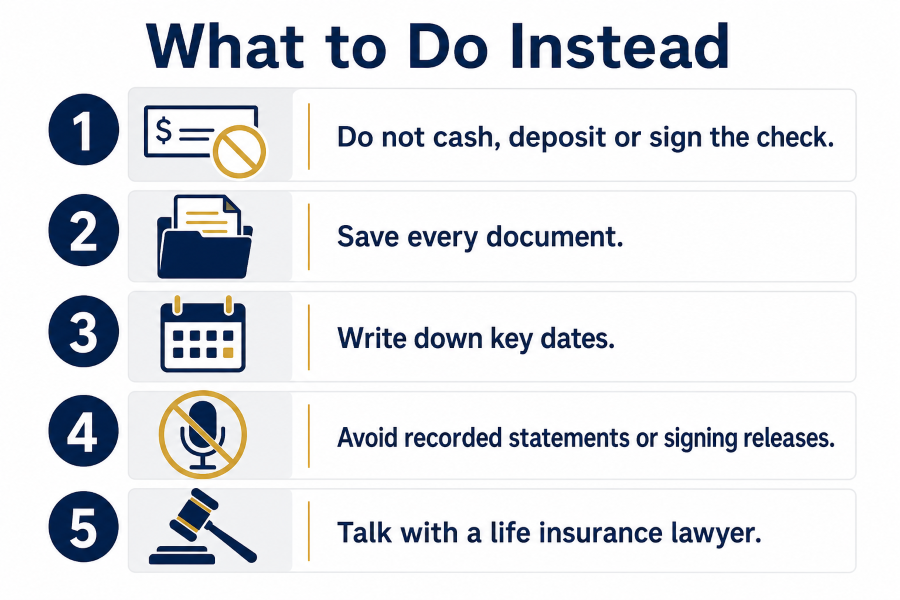
What to Do Instead
- Do not cash, deposit or sign the check. Keep it, along with the envelope and any letter it came with.
- Save every document. This includes the policy, the application if you have it, the denial or rescission letter, and any emails or notes from calls with the insurer.
- Write down key dates. When was the policy issued? When did the insured pass away? When did you file the claim and receive the denial?
- Avoid recorded statements or signing releases until you understand what they mean.
- Talk with a life insurance lawyer who can review the reasons given for the rescission and whether they may hold up.
Florida’s Two-Year Contestability Period
Timing can matter a great deal. Florida Statutes section 627.455 generally provides that a life insurance policy becomes incontestable after it has been in force during the insured’s lifetime for two years from the date of issue, subject to limited exceptions such as nonpayment of premiums. Section 627.409 addresses when misrepresentations on an application may allow an insurer to avoid coverage.
So when a death occurs within the first two years, an insurer may investigate the application closely. That does not mean every rescission during this period is proper. Questions can arise about whether a statement was actually inaccurate, whether it was material, whether the insurer would truly have refused coverage, and whether the application questions were clear. Each of these issues may affect whether benefits can still be recovered.
Examples of Situations That May Be Worth a Second Look
The scenarios below are general illustrations to show the kinds of issues that can come up. They are not actual case results.
- A minor or unrelated health issue. A policyholder dies in a car crash, and the insurer rescinds because of an old, unrelated prescription that was not listed. A lawyer may look at whether that detail would have changed the insurer’s decision to issue the policy.
- An agent filled out the application. A widow learns that the insurance agent completed the health questions during a phone call. Questions may arise about who made the error and whether the insurer can hold it against the family.
- Vague application questions. An adult son receives a rescission letter citing a “condition” the insured may not have known had a formal diagnosis. The wording of the question itself may become important.
- A check arrives with a release. A beneficiary gets a refund check along with a form to sign. Before signing or cashing anything, a review of the paperwork may help protect the family’s rights.
Why Families Turn to the Law Offices of Jason Turchin
When an insurer refuses to pay, families want someone who will take their claim seriously. Attorney Jason Turchin and our team have years of experience helping people across Florida and beyond who are facing insurance denials and serious losses.
Our firm has been A+ rated by the BBB every year since 2014. Jason Turchin has been named to Super Lawyers from 2020 through 2026, was recognized as a Super Lawyers Rising Star in multiple years, holds an AVVO 10.0 Superb rating, and is AV Preeminent Peer Rated by Martindale-Hubbell. He also received the Martindale-Hubbell Client Champion Platinum Award in 2026 and is a member of the Million Dollar Advocates Forum and Multi-Million Dollar Advocates Forum. He is a #1 best-selling author on Amazon on accident law and has been featured by outlets including CBS Evening News, CNN, The New York Times, The Washington Post and The Wall Street Journal.
Awards do not guarantee any outcome. What they reflect is a long commitment to clients and to the legal community.
Frequently Asked Questions
Can I still fight the rescission if I already cashed the check?
Possibly. Cashing the check may make the claim more complicated, but it does not always end your options. The facts, the paperwork and the applicable law all matter, so it may help to speak with a lawyer as soon as you can.
Should I send the check back to the insurance company?
Not necessarily, at least not before getting advice. Returning it, holding it or responding in writing can each have different effects. A lawyer can help you decide the best way to handle it.
Is there a deadline to challenge a life insurance denial?
There are often time limits, and they can vary depending on the type of policy and whether it was provided through an employer. Waiting too long could affect your rights, so it is generally wise to act promptly.
What if the policy was through my loved one’s job?
Employer-provided life insurance may be governed by a federal law called ERISA, which can involve an internal appeal process and different rules. A lawyer can review which rules may apply to your claim.
Does it cost money to have my denial reviewed?
You can contact our office to ask about how we handle life insurance claims and what a review may involve.
Talk to Us Before You Cash That Check
A refund check may look like the end of the road, but it can be the moment when getting advice matters most. Keep the check, gather your documents and let us review what happened. Call 800-337-7755 or reach out to the Law Offices of Jason Turchin online to learn whether benefits may still be payable to your family.
