
Let Us Fight for
Your Rights!
Your Rights!










When a person dies from choking or suffocation caused by someone else’s negligence, such as a nursing home, daycare, restaurant, hospital, or product maker, Florida law may allow the estate’s personal representative to file a wrongful death claim for the family. A Miami choking death lawyer can review whether a claim may exist.
If your family lost someone to choking or suffocation in Miami-Dade, call the Law Offices of Jason Turchin at 800-337-7755 for a free consultation about your options.
| Question | Short answer |
|---|---|
| Can a family sue after a choking death? | Possibly, if negligence such as poor supervision, an unsafe product, or a medical error played a role in the death. |
| Who files the claim in Florida? | The personal representative of the estate generally files on behalf of the surviving family members and the estate. |
| How long does a family have to file? | Florida generally allows two years from the date of death, though some cases may have different deadlines. |
| What does a lawyer cost? | The firm works on contingency, so fees and costs are waived if there is no recovery. |
| Is every choking death someone’s fault? | No. A claim may exist only when a person or company failed to act with reasonable care. |
Choking and suffocation are leading causes of death, and many of these deaths happen in places where someone else was responsible for safety. Families often accept the loss as a tragic accident, yet a closer look sometimes shows missed warnings, unsafe conditions, or staff who did not respond.
Miami’s mix of high-rise living, busy restaurants, large nursing home populations, daycares, and hurricane-season generator use creates many settings where an airway can be blocked or oxygen cut off. When that happens because of carelessness, Florida’s Wrongful Death Act may give the family a path to accountability.
Choking and suffocation deaths can happen at home, in care facilities, in businesses, and on the job. The examples below are illustrations of situations families may face, not descriptions of actual clients or case outcomes.
Fire alone is a serious risk. According to the U.S. Consumer Product Safety Commission, in 2023, fires contributed to 5 percent or approximately 3,150 of the annual consumer product-related deaths.
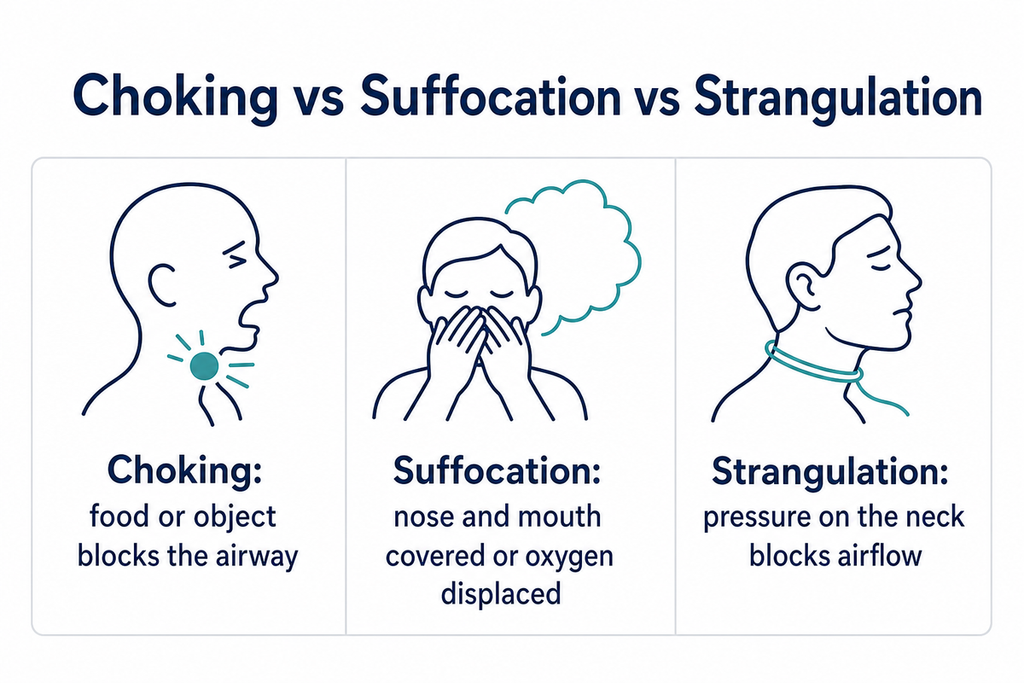
These terms describe different ways oxygen is cut off, and the difference can shape who may be responsible. Families often use them interchangeably, but investigators and medical examiners may not.
| Term | What happens | Common Miami examples |
|---|---|---|
| Choking | An object or food blocks the airway from inside. | Food in a nursing home, toy parts, clothing snaps |
| Suffocation | Air cannot reach the lungs because the nose and mouth are covered or oxygen is displaced. | Unsafe infant sleep, smoke, carbon monoxide, trench collapse |
| Strangulation | Pressure on the neck blocks airflow or blood flow. | Blind cords, crib gaps, improper restraint holds |
A Miami family may be able to file a wrongful death claim when a choking or suffocation death was caused by someone else’s wrongful act, negligence, or defective product. Florida Statute §768.19 allows a claim when the person could have sued had they survived.
Under Florida Statute §768.20, the claim is brought by the personal representative of the estate for the benefit of the survivors and the estate. Survivors are defined in Florida Statute §768.18 and can include a spouse, children, parents, and certain dependent relatives. Our guide on who can sue for wrongful death and who receives the money explains this in more detail.
Florida Statute §768.21 describes damages that may be available, such as lost support and services, loss of companionship, mental pain and suffering, and medical and funeral expenses. Some limits apply, especially in medical negligence cases.
Families can protect a possible claim by preserving evidence early, before records are lost or a facility “corrects” its paperwork. These steps may help:
Useful records to gather may include:
Florida generally gives families two years from the date of death to file a wrongful death lawsuit under Florida Statute §95.11. Claims against government agencies and medical negligence claims can involve extra notice requirements, so speaking with a lawyer early may help avoid missed deadlines.
Look for a firm with real wrongful death experience, independent ratings, clear fee terms, and a willingness to investigate complex causes of death. Ask how the firm works with medical records, product testing, and facility records in choking and suffocation cases.
Our article on how to find the best wrongful death attorneys in your area lists questions to ask during a consultation. You can also learn more about our Florida wrongful death lawsuit services.
The Law Offices of Jason Turchin is based in South Florida, and Attorney Jason Turchin and his team help Miami-Dade families look into deaths caused by unsafe products, careless care facilities, and negligent businesses. The firm handles personal injury cases in Florida, New York, New Jersey and Washington, D.C., and throughout the U.S. with a network of co-counsels and local counsels.
Cases are handled on a contingency fee basis, with fees and costs waived if there is no recovery.
It may be, especially if the resident had a known swallowing problem and staff ignored a prescribed diet or failed to supervise meals. Each case depends on the records and facts.
A manufacturer or seller may be liable if the product was defectively designed, poorly made, or lacked adequate warnings about small parts or choking hazards.
A claim may exist against a landlord, building owner, or product maker if missing detectors, blocked exits, or a defective appliance or generator contributed to the death.
No. The firm works on contingency, and fees and costs are waived if there is no recovery.
Our firm’s resources cover how Florida wrongful death claims work, who may file, and how damages are divided. A consultation can apply those rules to your family’s situation.
Losing someone to choking or suffocation is devastating, and your family deserves answers about what happened. Call the Law Offices of Jason Turchin at 800-337-7755 or contact us online for a free, confidential consultation.
