
Let Us Fight for
Your Rights!
Your Rights!











Updated October 2026
A Miami product liability lawyer represents people injured by defective products, such as faulty appliances, car parts, medications, medical devices and children’s products. Under Florida law, an injured person may be able to bring a claim against the manufacturer, a component maker, the distributor or the retailer. Florida sets strict deadlines for filing these claims.
If a defective product hurt you or someone in your family, call the Law Offices of Jason Turchin at 800-337-7755 for a free consultation about your options.
| Question | Short answer |
|---|---|
| What is product liability? | The area of law that holds those who design, manufacture or sell a product responsible when a defect in it injures someone. |
| Who can be held responsible? | The manufacturer, a component maker, the distributor and the retailer or seller may each be liable, depending on the facts. |
| What types of defects count? | Manufacturing defects, design defects and marketing defects, which are also called failure to warn. |
| What compensation can I seek? | You may be able to seek medical bills, lost income, future treatment, lost earning capacity, property damage and pain and suffering. |
| How long do I have to file? | Florida Statute §95.11 sets filing deadlines, and Florida Statute §95.031 adds a statute of repose. The period can depend on the claim, and missing either can end it. |
| What does a consultation cost? | The Law Offices of Jason Turchin offers a free consultation to review what happened. |
A product liability lawyer helps people who were hurt by faulty or dangerous products investigate what went wrong, identify who may be responsible and pursue compensation. In Miami-Dade County, that can mean claims involving anything from defective electronics to unsafe pharmaceuticals.
Product liability is the type of liability that covers the special legal considerations for those who design, manufacture or sell products, apparatus and equipment. It is different from workers’ compensation and premises liability, although a single injury can sometimes involve more than one of these. If you want a broader introduction, our article What Is Product Liability Law? explains the basics.
The Law Offices of Jason Turchin works with consumers impacted by faulty or dangerous products throughout Miami-Dade County, including Miami, Doral, Hialeah, Miami Beach, Coral Gables, Kendall and Homestead. Attorney Jason Turchin is an experienced personal injury lawyer who handles defective product claims and can review whether you may be entitled to compensation.
Defective products that commonly cause injuries include home appliances, vehicles and car parts, children’s products, medications and medical devices, and kitchen products such as pressure cookers. Product liability law is broad and varies from product to product.
Consumer products are tied to serious harm nationwide. According to the U.S. Consumer Product Safety Commission, falls contributed to more than 70 percent of all product-related deaths or an estimated 41,960 deaths in 2023. The same report states that in 2023, fires contributed to 5 percent or approximately 3,150 of the annual consumer product-related deaths.
Whether the company behind the product is a multinational corporation or a local producer, a Miami product liability lawyer can take on the legal process for you while you focus on your recovery.
Defective products can cause head and brain injuries, spinal cord damage, burns, broken bones, internal injuries, soft tissue injuries and deep cuts. Some of these injuries are life-altering, and some are fatal.
When a defective product causes a death, surviving family members may be able to bring a wrongful death claim. These cases call for careful investigation, patience and compassion for the family.
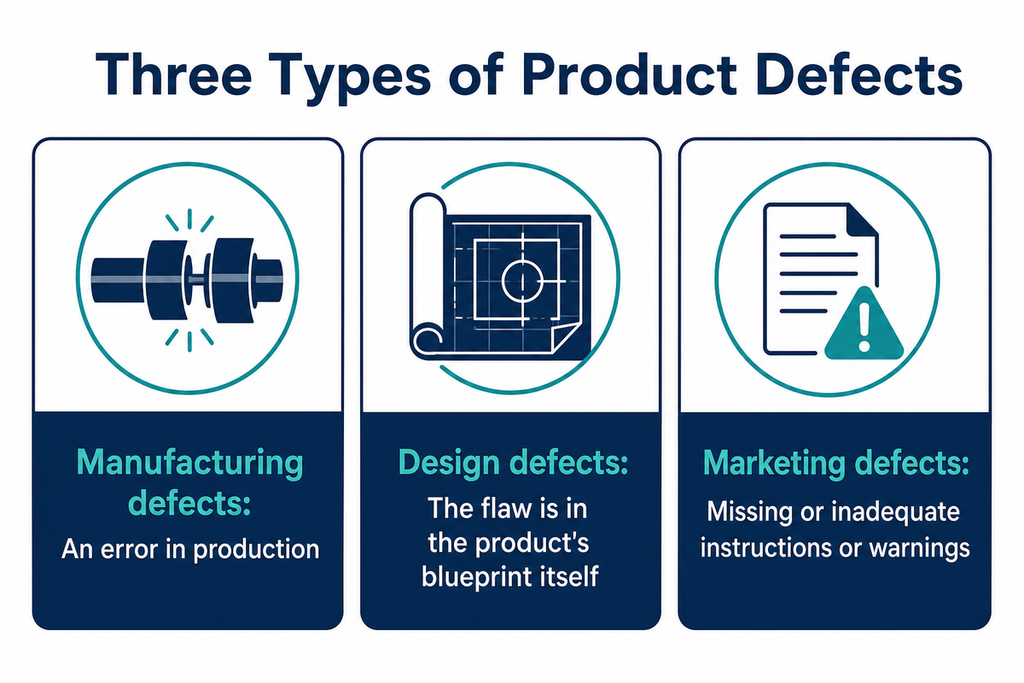
The three main types of product defects are manufacturing defects, design defects and marketing defects (also called failure to warn). Most Miami product liability cases fall into one or more of these categories.
In Florida, a product liability claim is usually proven under strict liability, negligence or both. Strict liability focuses on whether the product was defective, while negligence focuses on whether a company failed to use reasonable care.
Strict liability can hold manufacturers and sellers accountable if a product had an unreasonable defect or danger when it was sold and that defect injured the consumer. This means a company may still be held liable even if it took every possible precaution.
A negligence claim generally requires showing four elements:
Testimony from engineers, doctors and others who understand the product or industry often plays a central role. These witnesses can support the claim and explain complex technical details to a judge or jury.
The most important evidence in a defective product case is usually the product itself, followed by photos, medical records, witness accounts and proof of your financial losses. Recalls and reports of similar injuries can also help.
After a defective product injury, get medical care, preserve the product and contact a lawyer before the evidence is lost or a deadline passes. These steps can help protect a possible claim.
Anyone in the chain that brought a defective product to the consumer may be held responsible, including the manufacturer, a maker of a component part, the distributor and the retailer or seller. A thorough investigation looks at every party that may have contributed to the injury.
People injured by defective products may be able to recover economic damages, such as medical bills and lost income, and non-economic damages, such as pain and suffering. The amount depends on the facts of each case, and no result can be promised.
In limited cases, punitive damages may also be available.
Florida limits how long you have to file a product liability claim through both a statute of limitations and a statute of repose. Because the exact deadline can depend on the type of claim and when it arose, it is important to have a lawyer confirm your deadline as early as possible.
The statute of limitations, found in Florida Statute §95.11, is the time frame within which an injured person must file a lawsuit. In 2023, Florida shortened the deadline for many negligence claims to two years. Those changes may not apply the same way to every product claim, so many injured people may have as little as two years to act. If the deadline passes, a claim may be barred no matter how strong it is.
The statute of repose, found in Florida Statute §95.031, sets an outer limit that can bar a product liability lawsuit even when the harm only recently became evident. For most products, it generally runs 12 years from when the product was delivered to its first purchaser or lessee, rather than from the date of injury. There are exceptions, such as when a manufacturer knew of a defect and took steps to conceal it, which may stop the clock during the concealment.
A product liability class action is a single lawsuit in which a large group of people who were affected in the same way by the same product defect are represented together. It is used when bringing individual lawsuits would be impractical.
For a case to proceed as a class action, a court must certify the class. Certification generally requires that:
When individual claims would be economically inefficient, class actions give consumers a way to hold manufacturers accountable. They can also discourage corporate neglect.
In a mass tort, many people harmed by the same product each keep their own individual case, while in a class action they are represented together in one lawsuit. Mass torts are common when injuries vary a great deal from person to person.
Mass tort lawsuits may be brought against manufacturers, retailers or distributors when a product is believed to have caused harm through negligence, design defects or a failure to warn. Because each case is individual, each person can show how the product affected them, including the severity of the injury, the course of treatment and the financial losses.
Multidistrict litigation, or MDL, is a procedure that allows many similar federal cases to be consolidated before one court for pretrial matters. This promotes efficiency and consistency while each case keeps its individual character. Mass torts have followed problems such as medications with unexpected side effects and defective consumer products, electronic devices and vehicles.
Class Action vs. Mass Tort
| Point | Class action | Mass tort |
|---|---|---|
| How plaintiffs are grouped | All members are represented together in one lawsuit | Each plaintiff keeps an individual case |
| Court approval | The class must be certified by a court | No class certification is needed |
| How injuries are treated | Claims must be typical of the whole class | Each person’s injuries, treatment and losses are considered separately |
| Common use | Many people with similar claims, often similar financial losses | Many people with serious injuries that differ from person to person, such as from drugs or medical devices |
Whether to accept a product liability settlement depends on whether the offer fairly covers your current and future losses, because accepting usually means giving up the right to pursue the claim further. Many product liability cases settle before trial, so it is worth understanding the tradeoffs.
A settlement is an agreement in which the responsible party or its insurer pays compensation to resolve the claim without a trial. It can offer certainty, since trial outcomes are unpredictable, and it is often faster and less stressful than litigation.
There are also drawbacks. Settlements usually require a release of claims, which means you give up the right to take further legal action about the incident. An early offer may not fully cover long-term medical costs, and it will not include punitive damages that a court may award in some cases. Reviewing any offer with a lawyer before signing can help you make an informed decision.
To find a good product liability lawyer in Miami, look for an attorney with experience in defective product and personal injury cases, independent ratings and recognitions, clear fee terms and a willingness to explain your options. A free consultation is a good way to compare.
Things to check:
If you are searching for a product liability attorney near me, our page on finding a Miami injury lawyer near me may also help.
The Law Offices of Jason Turchin handles defective product and other personal injury claims for people throughout Miami-Dade County, and Attorney Jason Turchin brings recognized experience to these cases.
Product liability is the type of liability that covers the special legal considerations for those who design, manufacture or sell apparatus, equipment and other products. It is separate from workers’ compensation and premises liability.
Personal injury law firms with experience in defective product claims handle these cases in Miami. The Law Offices of Jason Turchin reviews product liability claims from people throughout Miami-Dade County, including Doral, Hialeah, Coral Gables and Homestead.
Under Florida product liability law, the manufacturer, a component maker, the distributor and the retailer or seller may each be held responsible, depending on the facts and how the product reached the consumer.
Possibly. Under Florida Statute §768.81, damages are generally reduced by your share of fault, and since 2023, a person found more than 50 percent at fault generally cannot recover damages in most negligence and product liability cases.
At the Law Offices of Jason Turchin, the consultation is free and cases are handled on a contingency fee basis, with fees and costs waived if there is no recovery.
A recall does not by itself prove a claim, but it may be useful evidence that a product had a defect. Keep the product and any recall notices, and speak with a lawyer about your options.
A Miami product liability lawyer can investigate what went wrong, gather evidence, identify every party that may be responsible, handle negotiations with insurers and represent you in court if needed. Taking on a large corporation can feel overwhelming, and having an experienced attorney handle the legal work can let you focus on getting better.
The Law Offices of Jason Turchin offers a free consultation, is available 24/7 and serves clients in Florida, New Jersey, New York and Washington, D.C. Call 800-337-7755 or fill out the contact form to speak with Attorney Jason Turchin about your defective product injury and learn whether you may be entitled to compensation.
