
Let Us Fight for
Your Rights!
Your Rights!











Step stools are commonly used in kitchens, bathrooms, garages, workplaces, and classrooms to help people reach elevated surfaces. Children’s kitchen helper stools and learning towers are also designed to allow young children to safely participate in cooking, handwashing, and other activities at countertop height.
Consumers generally expect these products to remain stable, support their advertised weight capacity, and resist collapsing or tipping during ordinary use. However, a defective step stool may suddenly fold, collapse, tip over, or allow a user to fall from an elevated platform.
These incidents may cause head injuries, fractures, spinal injuries, crush injuries, and other serious harm. Children and older adults may face an especially high risk of severe injuries.
A recent recall involving SDADI Kitchen Step Stools illustrates the potential dangers associated with poorly designed children’s step stools. Although the recall primarily concerns entrapment and fall hazards rather than a confirmed collapse defect, it highlights the serious injuries that may occur when elevated children’s products fail to provide adequate protection.
If you or a loved one suffered injuries after a step stool collapsed, tipped over, or otherwise failed, you may have legal options under product liability law.
At the Law Offices of Jason Turchin, we can represent individuals and families nationwide who have been injured by defective furniture, children’s products, ladders, step stools, and other consumer goods.
Step stools depend on several structural components working together to safely support a user.
A collapse may occur when:
Some failures may occur immediately after purchase, while others may develop after repeated use.
The fact that a stool has been used successfully before does not necessarily mean that it is free from a hidden defect.
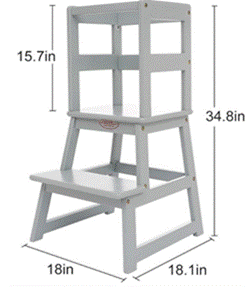
The U.S. Consumer Product Safety Commission announced a recall involving certain SDADI Kitchen Step Stools imported by Yiwushi Bihe Trading.
According to the recall notice, the children’s stools pose serious entrapment and fall hazards.
The recall serves as an example of how defects in children’s step stools and learning towers may expose young users to severe fall, entrapment, and elevated-platform hazards.
Parents and caregivers should immediately remove recalled products from children’s access and follow the recall instructions provided by the manufacturer.
A person standing on a step stool may have little opportunity to protect themselves if the product suddenly collapses.
The user may fall:
In addition, broken components may cause cuts, puncture wounds, or crush injuries.
Even a fall from a relatively low height may cause significant harm, particularly when the victim lands on their head, neck, wrist, hip, or back.
Step stool accidents may result in:
A user may strike their head on the floor, a countertop, or nearby furniture. Injuries may include concussions, skull fractures, brain bleeding, or permanent neurological damage.
People frequently extend their hands to break a fall, which may result in wrist, hand, forearm, or elbow fractures.
Older adults may suffer hip fractures or pelvic injuries that require surgery and extensive rehabilitation.
A sudden fall may cause herniated discs, spinal fractures, nerve damage, or other serious injuries.
Victims may strike cabinets, appliances, counters, or floors, causing facial fractures, dental injuries, and permanent scarring.
A collapsing metal or plastic frame may trap fingers, hands, feet, or other body parts.
In the most severe cases, a defective step stool may contribute to fatal head trauma, spinal injuries, or other catastrophic harm.
Children’s step stools are often referred to as:
These products elevate children above the floor, which makes stability and protective barriers especially important.
Potential safety concerns may include:
Because toddlers have limited balance, judgment, and coordination, even a minor design problem may create a serious risk of injury.
Many household step stools fold for convenient storage. However, the folding mechanism may become one of the most dangerous parts of the product if it does not lock securely.
Potential folding stool defects may include:
The stool may unexpectedly fold while a person is standing on it.
Fingers or hands may become trapped between folding components.
Weak hinges may bend, separate, or break under normal use.
Consumers may not receive clear instructions explaining how to confirm that the stool is fully locked.
The frame may be unable to safely support the stated weight capacity.
A product may be defective even when the user followed all assembly and operating instructions.
A person injured by a defective step stool may have several potential legal claims.
A lawsuit may allege that the stool’s design made it unstable or allowed it to fold, buckle, or collapse during foreseeable use.
A particular stool may contain a weak hinge, cracked component, missing fastener, defective weld, or other production problem.
The manufacturer may have failed to provide adequate instructions or warnings concerning weight limits, locking procedures, age restrictions, or known hazards.
Manufacturers, importers, or sellers may be accused of failing to reasonably design, test, inspect, or monitor the product.
Each claim often depends on the product, the manner in which it failed, and the evidence available after the accident.
Potentially responsible parties may include:
In some cases, more than one company may have participated in designing, manufacturing, importing, distributing, or selling the stool.
An attorney may investigate the full chain of distribution to determine which parties could potentially be responsible.
Not always, but it can be helpful. A recall does not automatically prove that a manufacturer or seller is legally responsible for a particular injury. However, recall information may become relevant when evaluating:
A claim may also exist even when the particular step stool has not been recalled.
A person injured by a defective step stool may be entitled to seek compensation for:
When a child is injured, a claim may also include future treatment, therapy, and other damages associated with long-term complications.
If a defective product contributes to a death, eligible surviving family members may have the right to pursue a wrongful death claim.
If a step stool collapsed or tipped over and caused injuries:
The stool itself may be the most important evidence in determining why the failure occurred.
Product liability cases often require an engineer or other qualified professional to inspect the failed product.
An inspection may help determine whether:
Discarding or repairing the stool may make it much more difficult to identify the cause of the failure. However, if the Defendant told you to throw it out or took it back, they could be precluded from using that against you.
Keep the product in a secure location and avoid allowing anyone to test or manipulate it unnecessarily.
The Law Offices of Jason Turchin represents individuals and families nationwide in claims involving defective furniture, step stools, ladders, children’s products, and other consumer goods.
In a step stool collapse case, our firm may assist by:
We handle qualifying cases on a contingency fee basis, meaning there are no attorneys’ fees or costs unless compensation is recovered.
For a free consultation, call (800) 337-7755.
Potentially. You may have a product liability claim if a defect caused or contributed to the collapse and your injuries.
A product does not have to be recalled for an injured person to pursue a claim. Recalls are only one potential source of evidence.
You may still have a claim if you followed the instructions and a product defect contributed to the failure. Assembly details should be carefully investigated.
Yes. Parents or guardians may pursue claims on behalf of children injured by defective learning towers, kitchen helper stools, or similar products.
The recall primarily concerns entrapment and fall hazards. It does not specifically identify collapse as the recalled defect. However, it highlights broader safety concerns involving elevated children’s step stools.
Keep the stool, all broken parts, packaging, instructions, receipts, photographs, witness information, and medical records.
That fact may support an investigation into whether the stool contained a design or manufacturing defect.
Potential compensation may include medical expenses, lost income, pain and suffering, disability, scarring, and future care costs.
Deadlines vary by state and the facts of the case. It is generally important to seek legal advice promptly.
Yes. The Law Offices of Jason Turchin represents clients throughout the United States through local counsels or co-counsel when needed.
