
Let Us Fight for
Your Rights!
Your Rights!










A silicosis diagnosis can change how you work, breathe, and care for your family. Our Silicosis Lawyers at the Law Offices of Jason Turchin can investigate your case to see if you may qualify for compensation or a silica injury lawsuit. Workers who spent years cutting stone or installing countertops may suddenly face permanent lung damage, mounting medical bills, and uncertainty about their future. If you or a loved one developed silicosis after exposure to silica dust, you may have legal options.
The Law Offices of Jason Turchin can review potential silicosis claims involving engineered stone, quartz countertops, granite, and other silica-containing materials. We evaluate matters involving workers in Florida, New York, and New Jersey, and work with attorneys across multiple states, including Illinois co-counsel, where appropriate.
Call 800-337-7755, use our live chat, or request a free silicosis case review. For cases we accept on contingency, there are no attorney’s fees or costs owed to our firm unless we recover compensation.
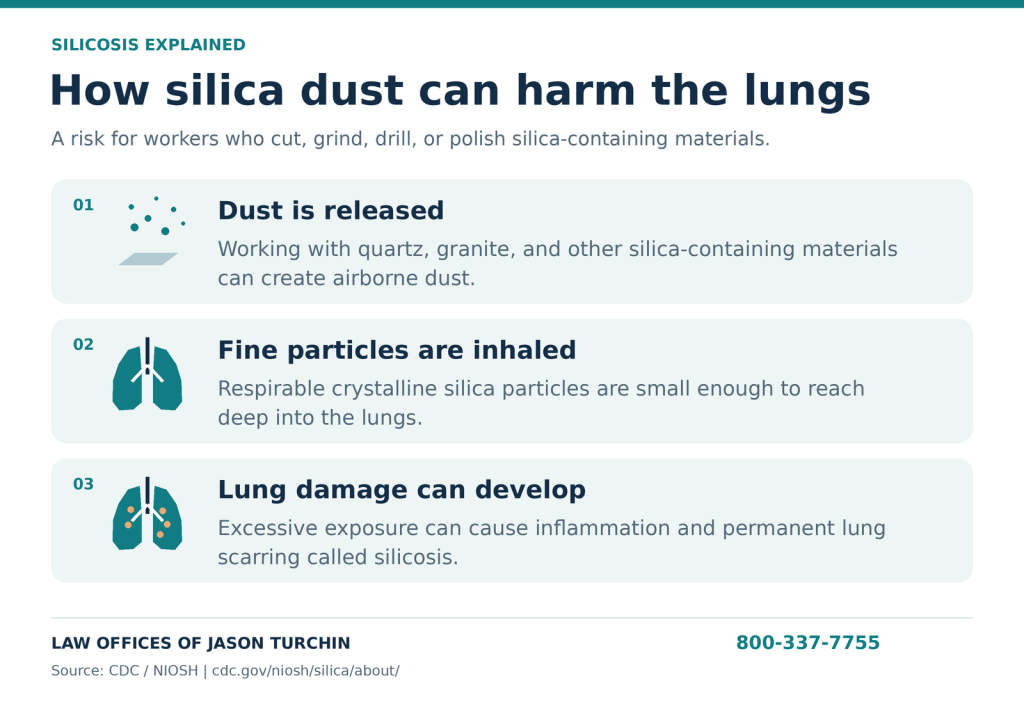
Silicosis is a lung disease caused by breathing respirable crystalline silica dust. These particles are small enough to travel deep into the lungs, where they can cause inflammation and permanent scarring. As the damage progresses, breathing may become increasingly difficult.
Crystalline silica occurs naturally in quartz, granite, sandstone, and other materials. Work that cuts, grinds, drills, or polishes those materials can release hazardous dust. The CDC’s National Institute for Occupational Safety and Health identifies both natural stone and engineered stone countertop fabrication as potential sources of exposure.
Silicosis has no known cure. Some patients develop severe disease requiring supplemental oxygen or evaluation for a lung transplant. The disease can continue progressing after exposure ends, making medical care and a careful review of past work conditions important.
Engineered stone, often marketed as quartz, artificial stone, or manufactured stone, combines stone particles with binding materials and pigments. Some engineered stone products contain up to 95 percent crystalline silica. Cutting and finishing these slabs can generate dust with a high concentration of silica.
Exposure may occur in fabrication shops, during countertop manufacturing, or while workers make adjustments at installation sites. Workers performing nearby tasks may also breathe dust generated by someone else.
Activities that may create exposure include:
The OSHA/NIOSH countertop silica hazard alert explains the risks and describes measures to reduce exposure. Wet methods, effective ventilation, exposure monitoring, training, and appropriate respiratory protection can be important. Whether these measures were available, adequate, and consistently used may become part of a case investigation.
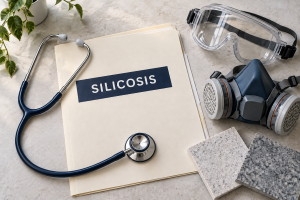
Yes. Silicosis is not limited to engineered quartz. Granite and other natural stone can contain crystalline silica, and cutting or grinding those materials can produce hazardous airborne dust. The amount of silica varies by material.
Our review may include countertop fabricators and installers, stonecutters, quarry workers, concrete workers, abrasive blasting workers, and people involved in tunneling or other dusty trades. The relevant questions include what materials you worked with, how the work was performed, and whether the exposure contributed to your diagnosed disease.
These claims concern inhalation of hazardous dust. Simply having an intact stone countertop in your home is a different situation from repeatedly cutting or grinding stone at work.
Silicosis symptoms can include persistent cough, shortness of breath, fatigue, and chest discomfort. Some workers first notice that climbing stairs, carrying tools, or keeping up with ordinary activities becomes harder. Early disease may cause few noticeable symptoms.
According to CDC guidance on silicosis symptoms and diagnosis, evaluation involves an exposure history, medical findings consistent with silicosis, and consideration of other possible causes of lung disease. Chest imaging and specialist evaluation may be important.
Silicosis can develop on different timelines:
If you have breathing problems and a history of stone or silica dust exposure, tell your medical provider about your work history. A lawyer can evaluate potential legal claims, but a healthcare professional should assess your condition.
A silicosis investigation looks beyond the diagnosis to identify how exposure occurred and which companies may bear legal responsibility. Depending on the evidence and applicable law, potential defendants may include manufacturers, importers, distributors, suppliers, or other parties involved with the materials or work conditions.
Our product liability lawyers can evaluate whether the facts support allegations involving:
Silica exposure alone does not generally establish that every company involved is liable. A claim typically requires evidence connecting the relevant product or conduct to the worker’s injury and satisfying the legal requirements of the jurisdiction. Product identification, historical warnings, work practices, and medical causation can all matter.
Yes. Workers’ compensation and a civil lawsuit against a responsible third party are different types of claims.
Workers’ compensation may provide medical treatment and certain wage or disability benefits for an occupational illness. Depending on state law and the circumstances, a worker may also have a separate claim against a company other than the employer, such as a product manufacturer.
Workers’ compensation laws generally limit lawsuits against employers, subject to applicable exceptions. A case review should therefore distinguish the employer’s role from potential claims against other parties. A dusty workplace does not automatically mean the worker can sue the employer in civil court.
If you already receive workers’ compensation or have a lawyer handling those benefits, tell us during your consultation. Related claims may need coordination, and reimbursement rights, liens, or settlement requirements can affect a third-party recovery.
Silicosis can affect a worker’s ability to earn a living and create substantial long-term care needs. A successful civil claim may allow recovery for losses permitted by the applicable law, including:
If a loved one died from silicosis, our wrongful death lawyers can review potential claims for the estate and eligible survivors. Who may bring the claim and which losses are recoverable depend on state law.
There is no standard silicosis settlement amount. Medical severity, future care, product identification, available evidence, defenses, and applicable law all affect the evaluation.
You do not need a complete set of records before contacting us. Start with what you know about your diagnosis and work history. We can discuss what additional information may be needed.
Helpful materials may include:
Keep relevant records and photographs you already lawfully possess. Do not expose yourself to additional dust to gather evidence. Even if a shop closed or you cannot remember every brand, other records or witnesses may help reconstruct your exposure history.
Workers may live in one state, have worked in another, and have used products supplied by companies elsewhere. Identifying the proper court and applicable law generally requires more than looking at the worker’s current address.
The Law Offices of Jason Turchin can evaluate potential silicosis matters involving Florida, New York, and New Jersey, as well as many other states. We also work with a team of attorneys across multiple states, including Illinois co-counsel. Depending on the matter, representation may involve a partner firm or local counsel.
Our co-counsel and attorney referral practice allows us to coordinate with other attorneys where appropriate. Before representation begins, the engagement documents explain which firm or firms will handle the case and the applicable fee arrangement.
Our practice includes serious injury, product liability, and wrongful death claims. We understand that investigating a potential product case may require medical review, technical evidence, corporate records, and collaboration with other lawyers and experts.
Attorney Jason Turchin has been selected to Super Lawyers annually from 2020 through 2026 and has received an AVVO 10.0 Superb rating and Martindale-Hubbell AV Preeminent recognition. The firm has maintained an A+ BBB rating annually from 2014 through 2026. Jason is also a member of the Million Dollar Advocates Forum list and Multi-Million Dollar Advocates Forum list.
Our goal is to explain your potential options, investigate whether a claim is supported, and pursue compensation when the facts and law permit. Awards and prior results do not guarantee the outcome of a particular case.
Possibly. Silicosis can be diagnosed after exposure ends. Your exposure dates, diagnosis, knowledge of the disease, and applicable filing deadlines need individual review. Do not assume an older exposure automatically prevents a claim.
Those facts are relevant but do not automatically resolve eligibility. The investigation may examine the protection provided, how it was used, actual exposure conditions, and whether other sources of dust remained.
Brand information helps, but you can contact us without remembering every product. Invoices, supplier records, photographs, slab labels, and coworker testimony may assist with identification.
Yes. We can discuss your circumstances and potential next steps. A legal claim typically requires evidence of injury and causation, and a medical professional should evaluate symptoms and determine the diagnosis.
Deadlines vary by jurisdiction and claim type. Diagnosis, discovery of the cause, exposure history, and other rules may affect timing. Contact a lawyer promptly rather than assuming the deadline starts on your last workday.
The initial consultation is free. For matters our firm accepts on contingency, no attorney’s fees or costs are owed to our firm unless there is a recovery. Your written agreement explains the terms.
If you or a loved one developed silicosis after working with quartz countertops, granite, engineered stone, or other silica-containing materials, contact the Law Offices of Jason Turchin. Tell us where you worked, what materials you handled, and what your doctors have diagnosed.
Call 800-337-7755, speak with our live chat agents, or contact our firm online for a free consultation about your potential silicosis claim.
